
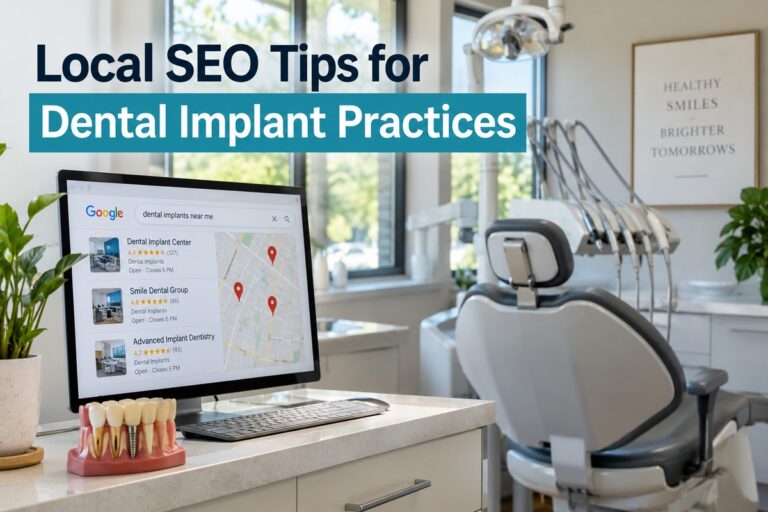
Local SEO tips for dental implant practices can help implant dentists reach patients who are actively searching for treatment in their area. Because dental implants are a high-consideration service, prospective patients often spend time comparing local providers, reading reviews, checking credentials, and researching treatment options before requesting a consultation.
A strong local SEO strategy makes it easier for your dental implant practice to appear during those searches. By improving local rankings, strengthening your Google presence, and creating useful location-focused content, your practice can attract more qualified website visitors and turn local searches into implant consultations.
Optimize Your Google Business Profile for Dental Implant Searches
Your Google Business Profile is an important part of dental implant local SEO. It can influence how prominently your practice appears in Google Maps and local search results when someone searches for terms such as “dental implants near me” or “implant dentist near me.”
Make sure your practice information is accurate and consistent. Your practice name, address, phone number, website, business hours, and other details should match the information displayed on your dental implant website.
Choose the most accurate primary business category available for your practice and add appropriate secondary categories where relevant. Avoid selecting categories simply because they contain desirable keywords.
Your profile should also give prospective patients useful information about the practice. Add high-quality photos of your office, treatment areas, dentists, staff, and exterior so patients can recognize the location and get a better sense of the practice.
Keep the profile active by reviewing information periodically and updating details whenever office hours, contact information, services, or other important information changes.
Target Local Dental Implant Keywords
Local keyword research should focus on the phrases prospective patients use when they are ready to investigate treatment.
Broad keywords such as “dental implants” are useful, but they can be highly competitive and may not indicate where the searcher wants treatment. Adding geographic intent can make your SEO strategy more relevant to potential patients in your service area.
Examples of useful local dental implant keywords include:
- Dental implants in “City”
- Dental implant dentist in “City”
- Implant dentist near me
- Dental implants near me
- Full mouth dental implants in “City”
- All-on-4 dental implants in “City”
- Implant-supported dentures in “City”
- Dental implant consultation in “City”
- Dental implant specialist in “City”
- Same-day dental implants in “City”, if offered by the practice
- Dental implant cost in “City”
- Full arch dental implants in “City”
Use these terms naturally throughout service pages, location pages, headings, page titles, meta descriptions, image alt text, and supporting content.
Avoid inserting the city name into every paragraph. Keyword repetition that makes a page awkward to read is unlikely to improve the patient experience. The goal is to establish clear relevance between the treatment, practice, and geographic area while still writing for real people.
Create a Dedicated Dental Implant Service Page
If dental implants are an important service for your practice, they should have a dedicated page rather than being mentioned briefly on a general dentistry page.
The page should thoroughly address the treatment and the questions prospective implant patients are likely to have.
Cover Specific Implant Treatments
Create sections for the dental implant services actually provided by the practice. Depending on the office, these might include single-tooth implants, multiple implants, full arch dental implants, implant-supported dentures, All-on-4 treatment, bone grafting, or related procedures.
Explain the available options clearly while giving patients an obvious way to request a consultation.
Include Local Information Naturally
Connect the service page to the location without forcing geographic keywords into every section.
For example, the page can discuss patients seeking dental implants in the city and surrounding communities, provide directions to the practice, or mention relevant areas the office regularly serves.
This gives search engines and prospective patients stronger geographic context.
Build Useful Location Pages
Dental practices serving several cities or communities may benefit from dedicated location pages. These pages should provide meaningful information rather than changing the city name across otherwise identical content.
A useful location page can discuss the dental implant services available to patients from that area, the practice location, travel considerations, consultation process, financing options, and relevant treatment information.
Avoid Thin City Pages
Creating dozens of nearly identical pages for surrounding cities can result in a poor user experience and weak content.
Instead, focus on locations that genuinely make sense for the practice. Each page should contain enough unique information to be useful to someone specifically searching for an implant dentist serving that area.
Improve Your Local On-Page SEO
Individual pages should make their subject and location easy for both patients and search engines to understand.
Important on-page elements include:
- A descriptive SEO title containing the primary service and relevant location
- A clear H1 focused on the page’s main topic
- H2 and H3 headings covering specific dental implant questions and services
- A compelling meta description
- Natural use of local dental implant keywords
- Internal links to related implant and practice pages
- Descriptive image alt text where appropriate
- Clear contact and consultation information
For example, a dental implant page could use a title such as “Dental Implants in Denver, CO | Practice Name” rather than a generic title such as “Our Implant Services.”
Keep titles specific and readable instead of filling them with multiple variations of the same keyword.
Strengthen Your Practice’s Local Citations
Consistent business information across reputable directories helps establish a clear online presence for the practice.
Check major directories, dental directories, professional profiles, mapping platforms, and other legitimate listings where the practice appears.
Pay particular attention to the practice’s:
- Name
- Address
- Phone number
- Website
- Business hours
Old phone numbers, outdated addresses, duplicate listings, and inconsistent practice names can create confusion for prospective patients.
Quality matters more than creating listings on every directory available. Prioritize reputable platforms and directories that are relevant to local consumers, healthcare, dentistry, or your geographic market.
Develop a Dental Implant Review Strategy
Reviews can play an important part in how prospective patients evaluate implant practices. Dental implant treatment can represent a significant financial and personal decision, so patients may look closely at other people’s experiences before contacting an office.
Encourage patients to leave genuine reviews after appropriate points in their experience, while following applicable platform policies and healthcare privacy requirements.
Do not tell patients what to write or pressure them to include specific keywords. A natural review profile is more useful and credible.
Respond Professionally to Reviews
Responding to reviews demonstrates that the practice pays attention to patient feedback.
Keep responses professional and avoid confirming treatment details or revealing protected health information. Even when a reviewer discusses their own procedure publicly, the practice should be cautious about what it discloses in its response.
Create Local Dental Implant Content
Supporting content gives your website opportunities to answer more specific searches related to implant treatment.
Instead of publishing broad dental articles unrelated to your core services, build content around questions prospective implant patients actually search for.
Useful topics could include:
- How much do dental implants cost in “City”?
- Dental implants vs. dentures
- What affects the cost of full mouth dental implants?
- How long does the dental implant process take?
- Who may be a candidate for full arch dental implants?
- What happens during a dental implant consultation?
- Dental implant financing and payment options
- Questions to ask an implant dentist
- What to expect during dental implant recovery
Where appropriate, these articles can link to your main dental implant service pages. This creates stronger internal connections between informational content and pages designed to generate consultations.
Optimize for “Near Me” Searches
You do not need to repeatedly place the phrase “near me” throughout your website to target “dental implants near me” searches.
Google can use location signals to determine which practices are relevant to a local search. Strengthening those signals is generally more useful than awkwardly inserting “near me” into page copy.
Focus on accurate business information, a complete Google Business Profile, relevant local pages, quality citations, reviews, location information, and strong dental implant content.
Make Your Location Easy to Find
Your website should clearly display the practice’s physical location and contact information.
A dedicated contact or location page can include the full address, phone number, business hours, directions, parking information, and communities served. Make it easy for someone considering treatment to understand where the practice is located and how to get there.
Build Relevant Local Backlinks
Backlinks from reputable websites can strengthen the authority of a dental practice website. For local SEO, links that have genuine geographic or industry relevance can be particularly useful.
Potential opportunities may include local business organizations, community organizations, professional dental associations, legitimate healthcare directories, local publications, sponsorships, and organizations the practice is genuinely involved with.
Avoid purchasing large quantities of low-quality backlinks or participating in link schemes. A smaller number of legitimate, relevant links can be more valuable than hundreds of links from unrelated websites.
Use Internal Links to Strengthen Important Implant Pages
Internal linking helps search engines understand how pages on your website relate to one another. It also helps prospective patients continue researching without having to return to the main navigation.
An article discussing full mouth dental implants, for example, can link naturally to the practice’s main full arch implant page. A dental implant cost article can link to financing information and the consultation page.
Use descriptive anchor text rather than generic phrases such as “click here.”
Anchor text such as “full mouth dental implant options” or “schedule a dental implant consultation” gives visitors more context about the page they are about to visit.
Improve Dental Implant Website Speed and Mobile Usability
Local searches frequently happen on mobile devices. Someone searching for an implant dentist may immediately visit a practice website, look at reviews, check the address, or call the office.
A slow or difficult-to-use mobile website can create unnecessary friction.
Compress oversized images, remove unnecessary scripts and plugins, use appropriate image formats, and monitor important page performance metrics. Calls to action, navigation menus, forms, phone numbers, and consultation buttons should also work properly on smaller screens.
Simplify Consultation Forms
Avoid asking prospective patients to complete an unnecessarily long form before contacting the practice.
Request the information the office genuinely needs to start the conversation. Make phone numbers easy to tap on mobile devices and position consultation calls to action logically throughout high-intent implant pages.
Add Relevant Structured Data
Structured data can give search engines clearer information about your website and business.
Depending on the content of the site, appropriate structured data may help identify business information, dentists, addresses, website pages, breadcrumbs, and other page elements.
Structured data should accurately represent visible information on the website. Do not add misleading information or markup content that does not exist on the page simply in an attempt to gain additional search visibility.
Pay Attention to Dental Implant Search Intent
Not every dental implant search has the same purpose.
Someone searching “what are dental implants” is likely at a different stage than someone searching “dental implant dentist near me.” Your website should contain pages that serve different stages of the patient’s research process while giving high-intent visitors a direct route to consultation information.
Prioritize High-Intent Local Searches
Commercial and treatment-focused pages should target searches closely connected to choosing a provider.
Terms involving location, cost, consultations, full mouth treatment, specific implant procedures, and nearby providers can indicate stronger local intent.
Informational articles can support those pages by answering earlier-stage questions and directing interested readers toward the appropriate treatment page.
Track Local SEO Performance and Patient Leads
Rankings are useful, but they should not be the only measurement used to evaluate dental implant SEO.
A practice can rank for many keywords without generating meaningful patient inquiries. Track actions that indicate whether local search traffic is contributing to practice growth.
Useful measurements can include:
- Organic dental implant traffic
- Local keyword visibility
- Google Business Profile interactions
- Calls from organic search
- Implant consultation form submissions
- Conversion rates on implant landing pages
- Traffic to location pages
- New patient inquiries attributed to organic search
Pay particular attention to whether the website is attracting people searching for the implant treatments the practice wants to provide.
Keep Practice Information Consistent When Details Change
Local SEO problems can develop when a dental practice moves, changes its phone number, updates business hours, adds a location, or changes its name.
When important business information changes, update the website and major online profiles as promptly as possible.
Check the Google Business Profile, website contact information, major directory listings, social profiles, professional listings, and other prominent citations. Consistency makes it easier for prospective patients to find accurate information about the practice.
Turn Local Visibility Into Dental Implant Consultations
Strong rankings have limited value if visitors arrive on the website and cannot determine why they should contact the practice.
Dental implant pages should make important information easy to find. Clearly present the implant services offered, provider information, office location, consultation process, patient resources, financing information where applicable, and a straightforward method of contacting the practice.
Local SEO for dental implant practices works best when search visibility and the patient experience support each other. Target relevant local dental implant keywords, develop substantial treatment and location pages, maintain accurate business information, earn legitimate reviews and citations, improve website performance, and make it easy for prospective patients to take the next step.
When those elements work together, a dental implant practice can build stronger visibility for valuable searches such as “dental implants near me,” “implant dentist in “City”,” and “full mouth dental implants in “City” while attracting prospective patients who are actively researching treatment in the local area.
Content reviewed and published by Parrot Branding Editorial Team.