
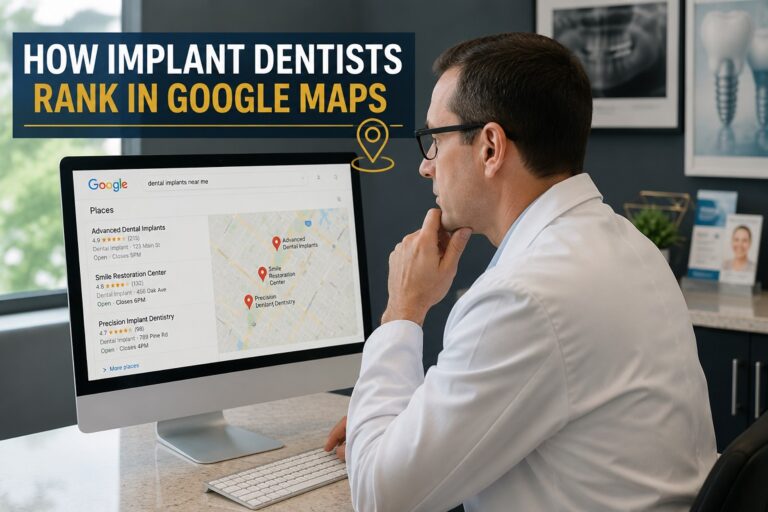
Implant dentists rank in Google Maps by building strong local relevance, trust, and authority across their online presence. For practices that want to attract more dental implant patients, appearing in the Google Map Pack is one of the most effective ways to generate qualified local leads. Patients searching for dental implants are often ready to schedule consultations, making Google Maps visibility an important part of a successful dental marketing strategy.
Google considers numerous ranking signals when determining which implant dentists appear at the top of local search results. From optimizing your Google Business Profile to earning quality reviews and building local authority, every element contributes to stronger rankings. Understanding these ranking factors helps implant dentists create a long-term strategy that consistently increases local visibility and attracts more patients.
Optimize Your Google Business Profile for Implant Keywords
A fully optimized Google Business Profile is one of the strongest ranking factors for Google Maps. Every section should accurately reflect the services your practice offers while naturally including keywords related to dental implants.
Important optimization areas include:
- Select the most relevant primary and secondary business categories.
- Include dental implant services throughout the business description.
- List every implant-related service available.
- Add high-quality office, team, and treatment photos.
- Keep business hours accurate.
- Add your website URL and appointment link.
- Answer patient questions within the profile.
- Publish regular Google Business Profile updates.
Google favors complete, active business profiles that demonstrate they are well maintained.
Use Location Specific Keywords Throughout Your Website
Google Maps rankings are closely connected to your website’s local SEO.
Instead of targeting only broad keywords like “dental implants,” create pages that combine your services with your service areas.
Examples include:
- Dental implants in Dallas
- Full mouth dental implants in Chicago
- Implant dentist in Phoenix
- All-on-4 dental implants in Tampa
- Same day dental implants in Denver
These location-based keywords help Google better understand where your practice provides services.
Each service page should contain unique, detailed content rather than duplicate text across multiple cities.
Create Dedicated Implant Service Pages
Many dental practices combine all implant treatments onto a single page. A stronger SEO strategy is creating individual pages for each major implant procedure.
Examples include:
- Single tooth dental implants
- Full mouth dental implants
- All-on-4 dental implants
- Implant supported dentures
- Bone grafting
- Sinus lifts
- Implant consultations
- Teeth in a Day
Dedicated pages allow Google to match highly specific patient searches with relevant content.
These pages also provide additional opportunities to rank organically while supporting stronger Google Maps performance.
Build Consistent Local Business Information
Google wants confidence that your business information is accurate everywhere online.
Your practice name, address, and phone number should remain identical across every directory and citation.
Consistency should include:
- Google Business Profile
- Yelp
- Healthgrades
- Vitals
- Bing Places
- Apple Maps
- Local chamber of commerce listings
- Dental directories
Even small differences such as abbreviating “Street” on one listing but spelling it out on another can create unnecessary inconsistencies.
Generate High Quality Google Reviews
Reviews remain one of the strongest local ranking signals.
Google pays attention to:
- Total review count
- Overall rating
- Review frequency
- Review quality
- Keywords mentioned naturally by patients
- Owner responses
Instead of asking every patient for a generic review, encourage satisfied implant patients to describe their experience in their own words.
Reviews mentioning phrases like dental implants, implant consultation, full mouth restoration, or All-on-4 treatment provide additional topical relevance without sounding manipulated.
Responding professionally to every review also demonstrates active engagement.
Publish Local Content That Supports Implant SEO
Google rewards websites that consistently publish useful content.
Instead of creating generic dental articles, focus on topics patients actually search before choosing an implant dentist.
Examples include:
- How long dental implants last
- Implant recovery timeline
- Dental implant financing options
- Bone grafting before implants
- Choosing the right implant dentist
- Implant treatment stages
- What affects dental implant success
Adding local references throughout these articles further strengthens geographic relevance.
Earn Local Backlinks
Backlinks remain an important ranking factor for both organic SEO and Google Maps.
Quality matters far more than quantity.
Helpful backlink opportunities include:
- Local news websites
- Community organizations
- Dental associations
- Chambers of commerce
- Sponsorship pages
- Local charities
- Educational organizations
- Professional partnerships
These links help establish authority within your local market.
Avoid purchasing backlinks or participating in low-quality link schemes that may damage rankings.
Improve Website Speed and User Experience
A slow website creates friction for both users and search engines.
Patients searching for implant dentists often compare multiple practices within minutes.
A fast website encourages visitors to stay longer, view more pages, and schedule consultations.
Areas to optimize include:
- Image compression
- Mobile responsiveness
- Fast hosting
- Clean navigation
- Clear calls to action
- Secure HTTPS connection
- Fast page loading times
Google uses page experience as part of its overall evaluation of websites.
Strengthen Your Local Authority
Authority is built over time through consistent signals that demonstrate expertise within your geographic area.
Ways to strengthen local authority include:
- Publishing local implant case studies.
- Participating in community events.
- Supporting local charities.
- Speaking at community organizations.
- Joining local business groups.
- Building relationships with referring dentists.
- Earning mentions from trusted local websites.
These activities create natural online mentions that reinforce your practice’s credibility.
Add Structured Data to Your Website
Structured data helps search engines better understand your practice.
Proper schema markup can include information such as:
- Business details
- Reviews
- Services
- FAQs
- Office hours
- Contact information
- Geographic location
While schema alone does not guarantee higher Google Maps rankings, it improves Google’s understanding of your website and supports local SEO efforts.
Optimize Every Location Page
Practices with multiple offices should avoid using duplicate content.
Each location page should contain unique information about that office, including:
- Office photos
- Driving directions
- Nearby landmarks
- Staff information
- Local patient testimonials
- Implant services offered
- Contact information
- Frequently asked questions
Unique content helps prevent internal competition between locations.
Keep Google Business Profile Active
An inactive profile can gradually lose momentum.
Regular activity signals that your practice remains engaged with patients.
Ways to keep your profile active include:
- Publishing weekly updates
- Uploading new office photos
- Adding treatment images
- Responding to reviews
- Updating holiday hours
- Answering questions
- Reviewing suggested edits
Consistent activity supports long-term local visibility.
Improve Behavioral Signals
Google evaluates how users interact with your listing.
Positive engagement may include:
- More phone calls
- More direction requests
- More website visits
- Higher click through rates
- Longer website sessions
- Appointment requests
Improving your listing quality naturally increases these engagement signals.
Clear service descriptions, professional photography, compelling reviews, and accurate business information encourage patients to choose your practice over competitors.
Build Topical Authority Around Dental Implants
Practices that specialize in implant dentistry should demonstrate expertise throughout their website rather than relying on a single implant page.
Supporting content can cover:
- Implant technology
- Full mouth restoration
- Implant maintenance
- Sedation options
- Treatment planning
- Recovery expectations
- Bone preservation
- Implant supported bridges
As Google recognizes broader topical authority, your website becomes more relevant for implant-related searches, which can positively influence both organic rankings and Google Maps visibility.
Monitor Local SEO Performance
Successful Google Maps optimization requires ongoing measurement.
Track performance metrics such as:
- Google Maps rankings
- Local keyword rankings
- Website traffic
- Phone calls
- Direction requests
- Consultation requests
- Google Business Profile views
- Click through rates
Reviewing these metrics regularly helps identify opportunities for improvement before rankings begin to decline.
Ranking highly in Google Maps is rarely the result of one optimization. Implant dentists that consistently appear in the local Map Pack typically combine a well-optimized Google Business Profile, strong local SEO, high-quality reviews, authoritative content, accurate business information, and an excellent patient experience. By strengthening each of these ranking factors over time, dental implant practices can improve local search visibility, attract more qualified implant patients, and generate a steady flow of consultation requests from people actively searching for implant dentistry in their area.
Content reviewed and published by Parrot Branding Editorial Team.