
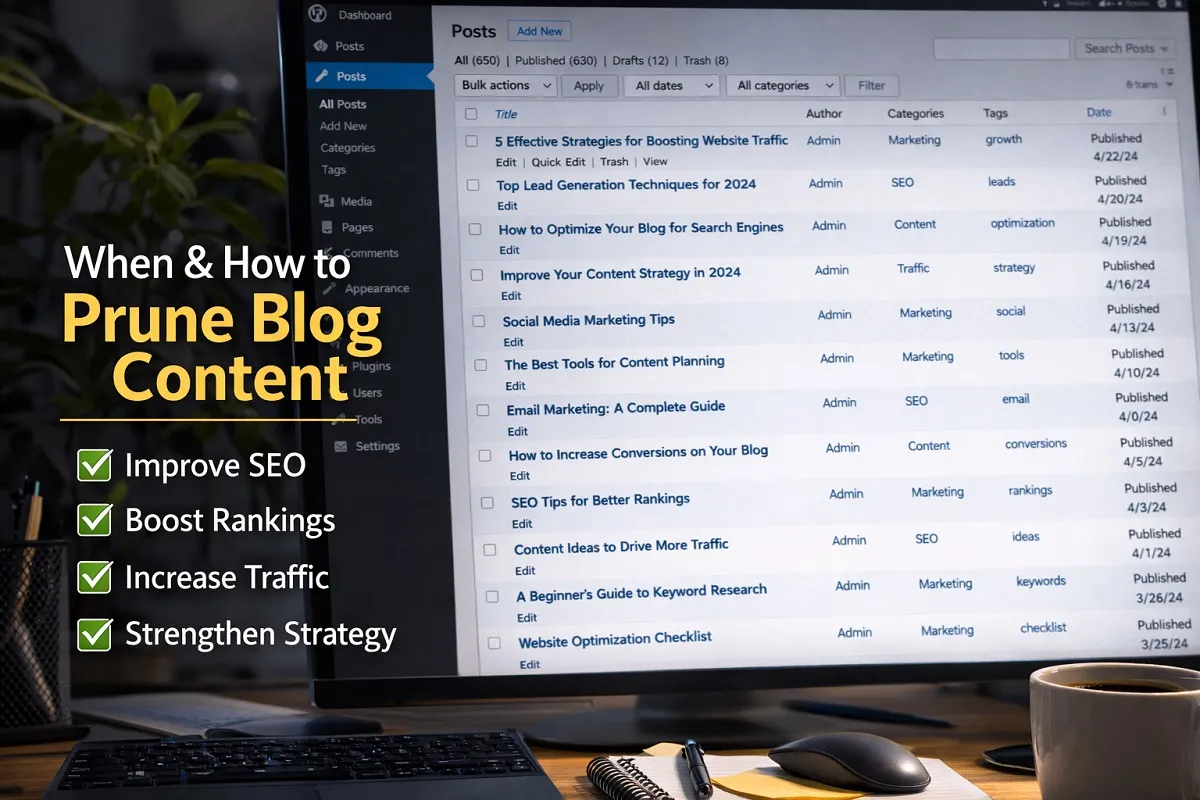
When and how to prune blog content is a critical part of maintaining a high-performing website that ranks well in search engines and delivers consistent value to readers. Blog content pruning helps improve organic traffic, strengthen topical authority, and eliminate outdated or underperforming pages that dilute SEO performance.
As your website grows, older posts can accumulate and compete for similar keywords, attract little traffic, or contain outdated information. Strategic content pruning ensures your blog remains optimized, relevant, and aligned with current search intent.
When to Prune Blog Content
Timing plays a major role in effective content pruning. Removing or updating content too soon can waste effort, while waiting too long can harm your search rankings.
Declining Organic Traffic
One of the clearest signs it is time to prune blog content is a steady decline in organic traffic. Use tools like Google Search Console and Google Analytics to identify:
- Pages that have lost rankings over time
- Blog posts with decreasing impressions
- URLs that once performed well but now attract minimal traffic
If content no longer aligns with search intent or has been overtaken by stronger competitors, it may require consolidation, updating, or removal.
Keyword Cannibalization
If multiple posts target the same keyword or closely related search terms, they may compete against each other. This weakens your authority and confuses search engines.
Look for:
- Several articles ranking for the same primary keyword
- Fluctuating rankings between similar posts
- Thin content variations on the same topic
Pruning in this case often means merging posts into a single authoritative resource and redirecting the weaker URLs.
Outdated or Irrelevant Information
Content that contains outdated statistics, expired offers, discontinued products, or obsolete strategies can hurt credibility and rankings.
Prune or update blog posts that include:
- Old year references that are no longer accurate
- Broken links
- Obsolete industry practices
- Information that conflicts with current standards
Fresh, accurate content performs better in search results and increases user trust.
Thin or Low-Quality Content
Pages with very little substance rarely perform well in competitive search results. If you have short posts that provide minimal value, consider improving or removing them.
Warning signs include:
- Fewer than 300 words with no depth
- Low engagement metrics
- No backlinks
- No meaningful keyword rankings
Not every short article needs deletion, but every page should serve a clear purpose.
Duplicate or Near-Duplicate Content
Duplicate or very similar content can dilute ranking potential and create indexing issues.
Watch for:
- Slightly reworded versions of the same topic
- Location-based pages with minimal variation
- Multiple short posts covering overlapping subtopics
Search engines prefer comprehensive, authoritative resources. Consolidating duplicate content improves keyword clarity and strengthens ranking signals.
Seasonal or Time-Sensitive Posts That Have Expired
Some blog posts are built around specific years, events, or limited-time promotions. Once those periods pass, the content may become irrelevant.
Examples include:
- “Best Marketing Strategies for 2021”
- Event-specific announcements
- Expired sales promotions
You can either update the year and refresh the content or merge evergreen elements into a more timeless guide.
Shifts in Search Demand
Search behavior changes over time. A keyword that once had strong search volume may decline significantly.
If a blog post targets a keyword with:
- Decreasing search volume
- Reduced commercial intent
- Replaced terminology in your industry
It may be time to update the targeting or consolidate the topic into a broader article that captures higher-value keywords.
How to Audit Your Blog Before Pruning

Before making changes, conduct a structured content audit. This ensures decisions are based on data rather than guesswork.
Step 1: Export All URLs
Gather a complete list of blog URLs. Include performance data such as:
- Organic traffic
- Impressions
- Click-through rate
- Backlinks
- Target keywords
Organizing this in a spreadsheet makes analysis easier.
Step 2: Categorize Each Post
Create clear categories to determine action steps. Common labels include:
- Keep as is
- Update and improve
- Merge with another post
- Redirect
- Remove
This framework prevents impulsive deletions.
Step 3: Evaluate Search Intent Alignment
Search intent changes over time. A post that once ranked may no longer match what users expect.
Review:
- Current top-ranking results
- Content format used by competitors
- Depth and structure of high-ranking pages
If your post does not align with the dominant format, it may need restructuring.
How to Prune Blog Content Effectively
Once you identify content to address, choose the correct pruning method. Each situation requires a strategic approach.
Updating Existing Content
Often the best option is improving what already exists.
Enhancements may include:
- Adding updated statistics
- Expanding sections with deeper insights
- Improving internal linking
- Optimizing headings with relevant keywords
- Refreshing meta descriptions and title tags
Updating content can revive rankings and increase organic visibility without losing existing authority.
Merging and Consolidating Posts
If two or more articles cover similar topics, combine them into one comprehensive guide.
Steps to merge blog posts:
- Identify the strongest performing URL.
- Consolidate valuable information from weaker posts.
- Rewrite into a cohesive, authoritative article.
- Implement 301 redirects from old URLs to the new consolidated page.
This strengthens keyword focus and improves topical authority.
Redirecting Low-Value Content
If a page has little value but still receives backlinks or traffic, use a 301 redirect to a relevant page instead of deleting it.
Redirects help:
- Preserve link equity
- Avoid broken links
- Maintain a positive user experience
Never redirect unrelated pages simply to avoid deletion. Relevance matters.
Deleting Content Carefully
Some posts may offer no value, no traffic, and no backlinks. In these cases, removal may be appropriate.
Before deleting, confirm:
- The page has no meaningful inbound links
- It does not rank for valuable keywords
- It is not part of a content cluster strategy
After deletion, ensure proper removal from your sitemap and update internal links.
SEO Benefits of Pruning Blog Content

Strategic content pruning can significantly improve website performance when executed correctly.
Improved Crawl Efficiency
Search engines allocate limited crawl resources. Removing low-value pages allows crawlers to focus on high-quality content.
This can lead to:
- Faster indexing
- Better ranking signals
- Stronger overall domain authority
Increased Topical Authority
Consolidated, in-depth articles perform better than multiple shallow posts. When you focus on comprehensive coverage, search engines view your site as more authoritative.
This strengthens your position in competitive keyword spaces.
Better User Experience
Visitors prefer up-to-date, relevant information. Eliminating outdated content improves navigation and reduces confusion.
A streamlined blog structure also increases engagement metrics such as:
- Time on page
- Pages per session
- Lower bounce rates
These signals indirectly support SEO performance.
Best Practices for Ongoing Blog Content Maintenance
Pruning blog content should not be a one-time task. Establish a structured process.
Conduct Annual or Biannual Audits
Depending on the size of your site, review blog performance every 6 to 12 months. High-volume sites may require quarterly reviews.
Consistency prevents content decay from accumulating.
Monitor Performance Metrics Regularly
Track:
- Organic traffic trends
- Keyword rankings
- Engagement metrics
- Conversion rates
Set benchmarks to quickly identify declining pages.
Strengthen Internal Linking
As you prune and update, optimize your internal linking strategy. Link related posts within topic clusters to reinforce keyword relevance.
This improves both crawlability and user navigation.
Maintain a Content Calendar
When new content is published, ensure it does not overlap excessively with existing articles. Proper planning reduces future pruning workload.
Common Mistakes to Avoid When Pruning Blog Content

Even experienced marketers make errors during content pruning. Avoid these pitfalls.
Deleting Pages Without Reviewing Backlinks
Removing a page with strong backlinks wastes valuable authority. Always check inbound links before deletion.
Ignoring Search Intent Shifts
Sometimes a page does not need removal but repositioning. Adjusting structure or keyword targeting may be enough.
Pruning Too Aggressively
Over-pruning can reduce indexed pages dramatically and hurt traffic. Balance removal with updates and consolidation.
Forgetting Redirects
Failing to implement 301 redirects results in broken links and lost link equity. Every removed or merged page should have a plan.
Building a Sustainable Content Strategy Through Pruning
When and how to prune blog content directly impacts your long-term SEO success. Instead of endlessly publishing new posts, refining and optimizing existing content often produces stronger returns.
A clean, well-maintained blog supports:
- Higher search engine rankings
- Improved keyword focus
- Stronger content clusters
- Better conversion potential
Pruning blog content is not about reducing volume. It is about increasing quality, relevance, and authority. By auditing regularly, making data-driven decisions, and applying structured optimization techniques, you create a streamlined content ecosystem that supports sustainable growth and long-term visibility in search results.
Content reviewed and published by Parrot Branding Editorial Team.